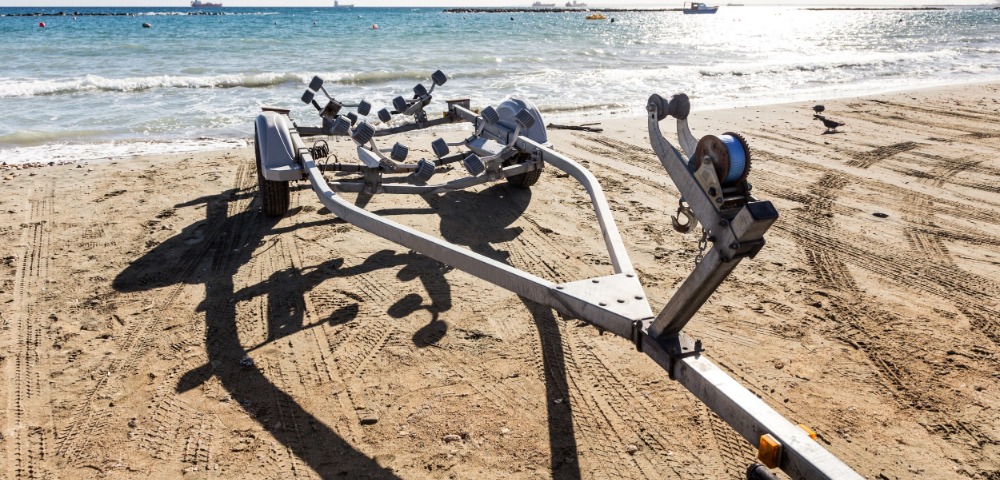
Building a trailer to accommodate your boat isn’t as simple as finding something big enough to house it. It needs to withstand the kind of abuse that—sadly—most trailer owners don’t pay for or inflict. Consider the kind of wear and tear a trailer experiences over its lifetime: Submerged in water day after day, having to deal with the corrosion of its environment, hitting stops at launch ramps, and dynamic loading when the boats shift in transit. Something that looks solid sitting on your driveway could crack and corrode after a season or two under the wrong circumstances.
But it’s crucial to understand what actually makes a trailer frame strong enough to avoid making the financially detrimental decision of constructing something or purchasing something that doesn’t last. Or, at worst, fails while your boat is on it.
Material Is Important
It’s not just what type of material your frame is made of, it’s how they make it.
First of all, the steel matters. Mild steel is cheap and easy to work with; however, it doesn’t hold up to marine environments without excellent protectant in a short time frame. Galvanized steel is more expensive but can withstand salt water in addition to exposure at the boat ramp. Some builders even use aluminum that’s marine grade, which doesn’t rust but requires a different skill set to weld and is even more expensive due to the cost of materials.
Second, you can’t just get whatever steel is cheapest at the metal shop. Different grades are necessary for structural applications. Thin-wall tubing isn’t effective, nor are low-grade options. Poor decisions could save money upfront but yield a frame that’s too flexible under load or experiences stress cracks at welded joints. Following boat trailer plans that have already been reviewed for structural integrity provide accurate material specs that involve guesses from unknown designs.
Third, thickness matters. A frame constructed with too thin material might hold initially but fatigue over time. A frame that’s too thick wastes excess funds and adds unnecessary dead weight. Attaining that balance is difficult without experience or by working from pretested plans.
Geometry Is More Effective Than Forced Strength
You can’t just weld a rectangle and assume that the angles are strong enough to hold the boat load successfully. The geometry of the frame—that is, how pieces are arranged and how they’re connected—determines how stress will be applied in angles and how loads will be transferred through the structure. Practical structures enhance stability through triangulation; good angles create rigidity instead of flexibility or twisting components.
For example, the main rails that run from front to back support most of the weight of the boat; however, they need adequate cross-members to avoid twisting. Too few cross-members will cause the frame to rack under load. But it’s also important that those cross-members are of sufficient quantity positioned effectively for stress application—not just positioned evenly for aesthetic purposes.
Joints at corners and connections need special attention because that’s where cracks happen most frequently. Sharp angles create stress; good designs have gussets or triangular reinforce sections. A well-planned frame deals with loads applied instead of visual perspectives.
Welding Quality Makes or Breaks Everything
Welds determine how stable a trailer will last over time. Poor welding is possibly the number one failure point in DIY applications. Where structural joints occur, full-penetration welds are necessary—the welds that go all the way through instead of merely throwing materials together.
Tack welds holding cans together will never hold a trailer properly together. In addition, tack welds and spots of insufficient penetration may hold up momentarily but cannot withstand repeated stress cycles.
The inherent problem with trailer welding is that it typically occurs in suboptimal weather conditions—outdoors where wind blows moisture, helps add contaminants through rain and road debris, causes issues when filler is inappropriate—even a subtle combination of everything can cause weak welds that look acceptable but fail prematurely.
Steel that’s going to be in the water needs special precautions in advance to remove elements. Galvanized steel needs attention afterward to ensure there’s no chemical retention to remain in positions where corrosion avoidance is necessary.
Heat creates expansion—impacts—and heat penetrates metal through the welded region, which creates delicate areas where metals weren’t designed to be deformed or stressed. This is crucial for galvanized steel because it removes coating right where it needs it most.
Corrosion Avoidance Keeps Everything Stable
A wonderfully designed trailer frame fails with corrosion; boat trailers live in corrosive environments. Saltwater is bad enough, but even freshwater creates rust over time; it needs extensive coverage—inside and out.
Galvanizing provides welded trailers an extra pinch; paint looks aesthetic but if any edges chip away, bare metal is exposed to inevitable rusting. The most vulnerable spots are the inside of boxed frame sections because they have water penetrate but do not drain or dry well; drain holes help but don’t alleviate all issues. Sections that are sealed filled with valuable materials or using open profiles that can drain effectively work better than hoping water won’t rest in tubing.
Consider Real World Conditions
One of these ideas may allude to working off known designs perverted in the real world problems effectively.
Trailers need to withstand real conditions—steep launch ramps with one wheel out of the water, side impact from wind, backing into things accidentally, overloading trailers from time to time, and potholes on the road creating expansive bumps rarely accounted for outside ideal conditions.
Angled ramps create unrealistic forces for frames when the back wheels are submerged and front wheels are still on the ramp; it’s as if the trailer isn’t leveled which creates different stress patterns than when it’s towed flat.
Storing trailers loaded under improper conditions for months at a time means a frame that’s appropriate for dynamic situations may slowly start bending over time sitting in someone’s driveway.
The difference between a build that lasts three years and one that lasts 30 comes down to appropriate decisions being made—the materials chosen, the proper geometry applied, quality welding participation, corrosion protection provision, loads honored based on confirmed deviations. Shortcuts taken on anything ensure frames will fail; it’s far easier for DIY builders to have proven plans that see these problems solved than attempt to develop strong fabrication skills and learn engineering nuances along the way.